Ways to Give
Every donor's journey is unique. Explore charitable giving options and learn how your support can create lasting impact through music.
Online, Check, and Cash Gifts
Most flexible · All ages welcome · Full benefits apply
How to give
Online: visit anchoragesymphony.org/donate for a secure, immediate gift
By check: payable to Anchorage Symphony Orchestra, mailed to 430 W 7th Ave, Ste 202, Anchorage, AK 99501
By phone: call our development team at 907-274-8668 to give by credit or debit card
Gifts of appreciated stock are also welcome and may carry tax advantages. Contact us for brokerage transfer details.
The simplest way to give, and the one with the fewest restrictions. Online donations are processed securely at any time, and checks are always welcome by mail. These gifts are fully eligible for all your member benefits at your giving level, including concert invitations, event access, and recognition in our programs.
Many employers match charitable gifts. Ask your HR department about matching programs. A matched gift can double or triple your impact on the music.
Donor Advised Funds (DAFs)
Fidelity Charitable, Schwab, DAFGiving360, Vanguard, and others
How to recommend a grant to ASO
Log in to your DAF account with your sponsoring organization
Search for Anchorage Symphony Orchestra or enter our EIN: 92-6002867
Enter your recommended grant amount and submit
Please let our team know a grant is coming and indicate whether you’d like your name included on the grant to your accountant. It helps us plan and thank you promptly.
Important limitations to know
No goods or services in exchange. IRS rules prohibit a DAF grant from being used to purchase anything with fair-market value. Concert tickets, event tickets, gala tables, parking vouchers, and drink tickets cannot be purchased using DAF funds. These must be paid with personal funds.
Champagne Pops Gala and special events. DAF funds cannot cover event admission or table purchases. The only exception is if you donate your entire table or seat back to the ASO and do not attend. Please check with your DAF sponsor.
Pledges cannot be fulfilled by DAF. You may recommend, but cannot legally direct, a DAF grant. An existing pledge commitment cannot be satisfied using DAF funds.
Membership benefits may be limited. If your DAF grant qualifies for a donor level with tangible benefits such as parking or invitations, some benefits may need to be declined. Please reach out to our development team before your grant is processed and we will work through it with you.
A Donor-Advised Fund is a charitable giving account held at a sponsoring organization such as Fidelity Charitable, DAFgiving360 (Schwab Charitable), or Vanguard Charitable. You contribute assets to the fund and receive an immediate tax deduction at that time, then recommend grants to nonprofits like the ASO over time. We gratefully accept DAF grants and welcome you to give this way.
Because the tax deduction happens when money enters your DAF and not when the grant is made, there are important IRS restrictions on what a grant can be used for. Please review these carefully before giving so there are no surprises.
Qualified Charitable Distribution (QCD)
IRA owners age 70½ or older · May count toward RMD
If you are 70½ or older and own a Traditional IRA, a Qualified Charitable Distribution (QCD) lets you transfer funds directly from your IRA to the ASO without that amount being counted as taxable income. This can be a powerful giving strategy, especially if you are taking Required Minimum Distributions (RMDs) but do not need the extra income. A QCD may satisfy all or part of your annual RMD requirement.
We are deeply grateful to our IRA donors. These gifts often represent some of the most meaningful support we receive each year.
Important limitations to know
No goods or services in exchange. A QCD cannot be used to purchase tickets, gala admission, parking, or any other benefit with fair-market value. These must always be paid with personal funds outside your IRA.
Age requirement. You must be at least 70½ on the date the distribution is made.
Annual limit. The annual QCD limit per individual is $105,000 (indexed for inflation). Please confirm the current year limit with your tax advisor.
Direct transfer required. The check must be issued by your IRA custodian directly to the ASO. If you receive the funds first, the QCD tax treatment is forfeited.
Cannot go to a DAF. QCDs cannot be directed into a Donor-Advised Fund. They must go directly to a qualified public charity like the ASO.
Traditional IRAs only. QCDs apply to Traditional IRAs. Other retirement account types such as 401(k), 403(b), and SEP-IRA have different rules. Please check with your financial advisor.
How to make a QCD to ASO
Contact your IRA custodian (the bank or brokerage that holds your IRA) and tell them you would like to make a Qualified Charitable Distribution to the Anchorage Symphony Orchestra
Provide our legal name and EIN (see the information box below)
Your custodian will issue a check payable directly to the ASO. Please do not take the funds yourself and then write a personal check, as this disqualifies the QCD tax treatment.
Start the process well before December 31. Funds must leave your IRA by year-end to count toward that year's RMD, and processing takes time.
Let us know your gift is on its way so we can watch for it and acknowledge you properly. Also, indicate to your accountant if you’d like to be named on their documentation.
Planned Giving/Legacy Gifts
Bequests · Beneficiary designations · Charitable trusts · Estate plans
A legacy gift to the Anchorage Symphony Orchestra is one of the most meaningful ways to ensure that great music continues to inspire our community for generations to come. Planned gifts can take many forms, and some of the most powerful are also the simplest to arrange. Many donors are surprised to learn that a legacy gift costs nothing today and requires only a conversation with your estate planning attorney or financial advisor.
If you have already included the ASO in your estate plans, we would love to hear from you. Donors who notify us of a planned gift become members of our legacy giving community and receive our deepest gratitude.
Things to know before you give
Work with your own advisors. Planned gifts involve your estate, tax situation, and long-term financial plan. Always work with a qualified estate planning attorney, financial planner, or tax advisor. The ASO cannot provide legal or tax guidance.
Use our legal name and EIN. To ensure your gift reaches us correctly, use our full legal name and federal tax ID in all estate documents and beneficiary designation forms (see the information box below).
Let us know. Planned gifts often remain unknown to us until after a donor has passed. If you have included the ASO in your estate plans, please consider letting us know so we can thank you and, with your permission, recognize your generosity during your lifetime.
Gifts can often be updated. Most planned gifts, including bequests and beneficiary designations, can be revised at any time. Your intentions are not locked in until the gift is actually received.
Common types of legacy gifts
Bequest in your will or trust. Leave a specific dollar amount, a percentage of your estate, or the remainder of your estate to the Anchorage Symphony Orchestra. This is the most common form of planned gift and can be arranged or updated at any time by working with your attorney.
Beneficiary designation. Name the ASO as a full or partial beneficiary of your IRA, 401(k), 403(b), life insurance policy, or other financial account. Retirement assets left directly to a nonprofit pass free of income tax, making this one of the most tax-efficient legacy gifts available. You can change a beneficiary designation at any time by contacting your account custodian.
Charitable Remainder Trust (CRT). Transfer assets into a trust that pays income to you or a loved one for life or a set number of years. At the end of the trust term, the remaining assets pass to the ASO. A CRT can provide income, reduce capital gains on appreciated assets, and generate a partial charitable deduction.
Charitable Lead Trust (CLT). The reverse of a CRT: the trust makes payments to the ASO for a set period, after which remaining assets pass to your heirs. This can be a useful tool for transferring wealth while supporting the arts.
Gifts of real estate or other assets. Real property, closely-held business interests, or other non-cash assets can sometimes be donated outright or through a trust arrangement. Please contact us to discuss whether this type of gift is feasible.
Regular Retirement Distributions
401(k) · 403(b) · IRA withdrawals · Pension income
Many of our generous supporters give to the ASO using income from their retirement accounts, including withdrawals from a 401(k), 403(b), pension, or a regular IRA distribution. This is a wonderful and fully valid way to give, and it comes with no restrictions on your member benefits. Your gift is treated exactly like any other cash donation.
The key distinction to understand is how this differs from a QCD. When you take a distribution and then donate the proceeds, that withdrawal is generally counted as ordinary taxable income first. A charitable deduction may be available if you itemize, but the net tax outcome differs from a direct QCD transfer. Your tax advisor can help you compare the two options.
What to keep in mind
Taxable income first. A regular retirement distribution is counted as ordinary income in the year you take it, even if you donate it right away.
You may still deduct the donation. If you itemize deductions on your federal return, a cash gift to the ASO is deductible. Please consult your tax advisor to understand the full picture.
Full benefits apply. Regular cash donations carry no restrictions on member benefits, even those funded from retirement account withdrawals. You receive your full benefits at your giving level.
You may still deduct the donation separately. Even though the distribution itself is taxable, a charitable deduction may offset that income if you itemize. Your tax advisor can help you model the comparison against a QCD.
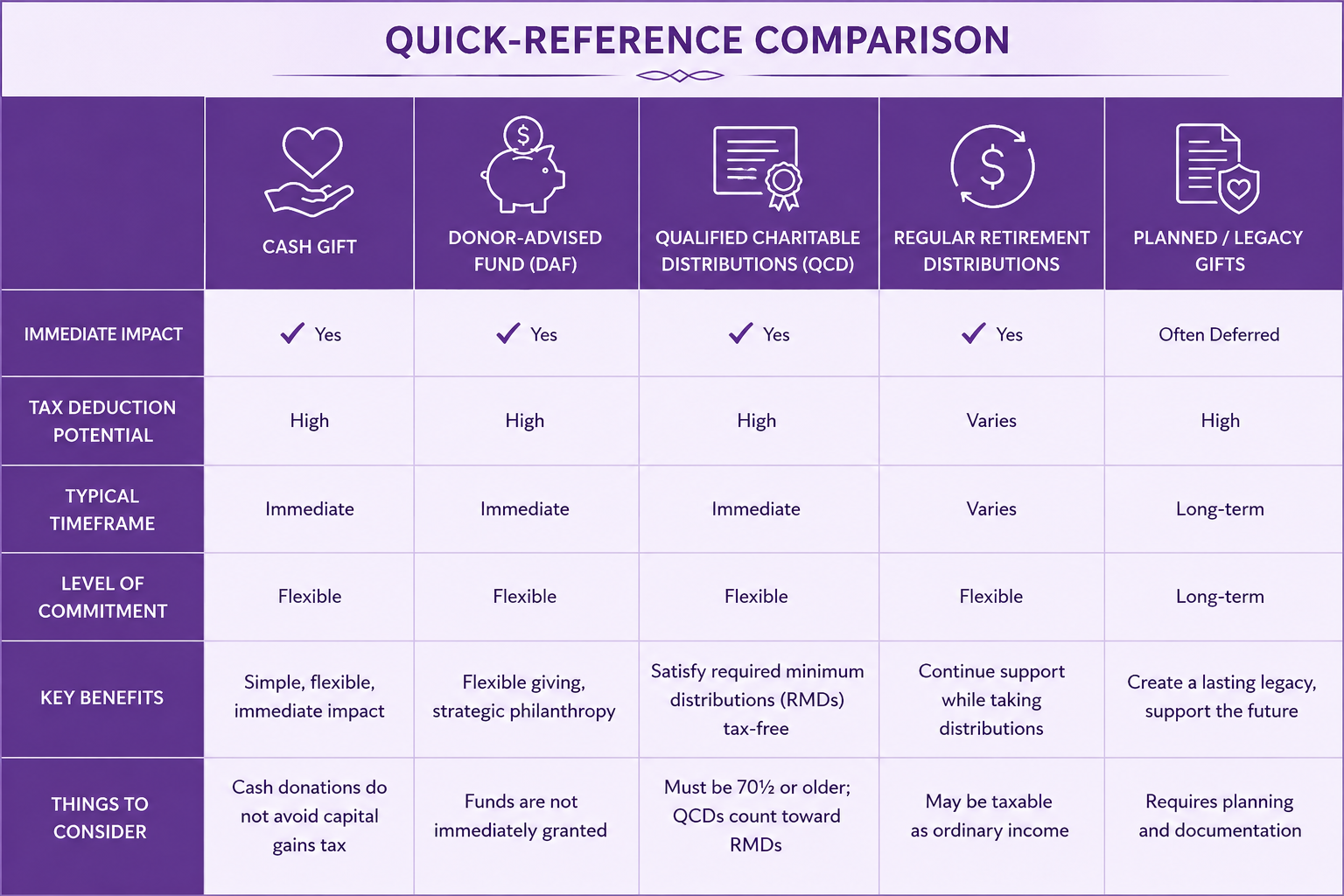
Questions? We Are Here to Help.
Our development team is happy to assist with your giving, whether you need our EIN for a DAF grant, guidance on initiating a QCD, or clarity on your member benefits.
ASO Giving Information
Legal Organization Name: Anchorage Symphony Orchestra
Federal Tax ID: (EIN)92-6002867
Mailing Address: 430 W 7th Ave, Suite 202, Anchorage, AK 99501
501(c)(3) Status: Public Charity. Gifts are tax-deductible as permitted by law.
A note about tax and financial guidance:
The information on this page is provided for general educational purposes only to help you understand common charitable giving methods and their general guidelines. It is not intended as tax, legal, or financial advice, and it may not reflect the most current IRS rules, annual limits, or your individual financial circumstances. Every donor's situation is unique. Please consult your personal tax advisor, financial planner, estate attorney, or IRA custodian before making charitable giving decisions, particularly those involving IRAs, retirement accounts, Donor-Advised Funds, or estate planning. The Anchorage Symphony Orchestra is not able to provide individualized tax or financial guidance.